
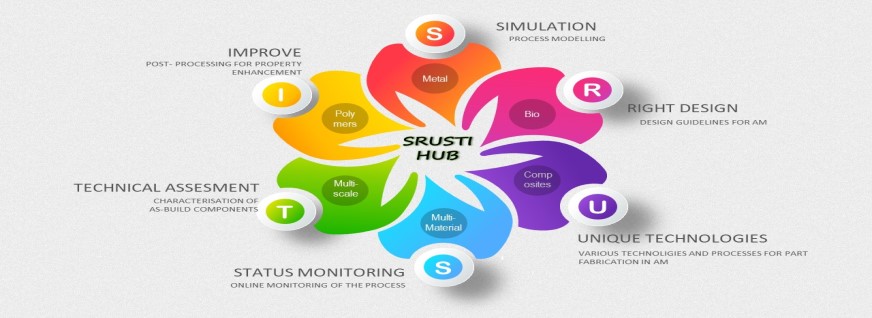
Additive Manufacturing (AM) or more popularly known as 3D Printing, is a rapidly evolving manufacturing approach with advantages over traditional fabrication increased design complexity, enhanced part customization and lower setup times. In particular, there is a significant interest in AM for biomedical, defense, and aerospace applications requiring high-temperature strength, higher strength-to-weight ratio, and corrosion resistance along with unparalleled design freedom. The eco-system of IIT Hyderabad (IITH) in terms of faculty expertise, courses, research projects, international conferences, short-term courses being offered etc. make it an ideal host for such a centre of excellence. The proximity of IITH to various defense R&D units is an added advantage. Total project funding generated exceeds INR 6.5 Crores
| Faculty | Department | Representative Project |
|---|---|---|
| Surya Kumar S | Mechanical and Aerospace Engineering | Thermal Management Approaches for Distortion Control in Metal Additive Manufacturing. |
| Bharat B. Panigrahi, | Materials Science and Metallurgical Engineering | Synthesis and Sintering of Ultrafine Grained MAX Phase Compounds |
| Prasad Onkar | Design | |
| M. Gopinath, | Mechanical and Aerospace Engineering | Real time monitoring and control of cooling rates in laser based additive manufacturing for ensuring microstructural homogeneity, controlling and dimensional accuracy, micro-craacks and delamination and investing their effects on the mechanical properties of fabricated components |
| Subhradeep Chatterjee | Materials Science and Metallurgical Engineering | Design Manufacturing & Microstructural Analysis of Novel Hard Coatings on Titanium Produced by Weld Deposition Techniques |
| Subha Narayan Rath | Biomedical Engineering | Development of Macro - encapsulation Device for Islet Cell Transplantation in Diabetes Treatment |
| Falguni Pati | Biomedical Engineering | 3D Printed Lower Limb Orthotics |
| Jytosnendu Giri, | Biomedical Engineering | Engineering Nanomedicine |
| Lopamudra Giri | Chemical Engineering | Integrated approach towards economic production of baculovirus pesticide- Combination of genetic engineering, systems biology and bioreactor design |
| Gangadharan Raju | Mechanical and Aerospace Engineering | Experimental Studieson Delamination Failure of Fiber Reinforced Composite Under Static and Fatigue Loading |
| Syed Nizamuddin Khaderi | Mechanical and Aerospace Engineering | Numerical Analysis of Blast Loading due to Explosions in Sand |
| Suhanya Duraiswamy | Chemical Engineering | |
| Viswanath Chintapenta | Mechanical and Aerospace Engineering | Bio-mechanical Simulations of Resuscitation |
| Rajesh Korla | Materials Science and Metallurgical Engineering | Evaluation of Creep Behavior of AlCoCrFeNiMo0.5 High Strength High Entropy Alloy |
Sunkari, Upender, S. R. Reddy, B. D. S. Rathod, D. Kumar, R. Saha, S. Chatterjee, and P. P. Bhattacharjee. “Tuning nanostructure using thermo-mechanical processing for enhancing mechanical properties of complex intermetallic containing CoCrFeNi2. 1Nbx high entropy alloys.” Materials Science and Engineering: A 769 (2020): 138489
Mohan, Shashi Ranjan, and Suryakumar Simhambhatla. “Fabrication of Gradient Density Components Through Extrusion-Based Additive Manufacturing.” In Advances in Additive Manufacturing and Joining, pp. 87-101. Springer, Singapore, 2020.
Jobin, T. M., Syed Nizamuddin Khaderi, and M. Ramji. “Experimental evaluation of the strain intensity factor at the inclusion tip using digital photoelasticity.” Optics and Lasers in Engineering 126 (2020): 105855.
Wilkinson, Angus J., David M. Collins, Yevhen Zayachuk, Rajesh Korla, and Arantxa Vilalta-Clemente. “Applications of multivariate statistical methods and simulation libraries to analysis of electron backscatter diffraction and transmission Kikuchi diffraction datasets.” Ultramicroscopy 196 (2019): 88-98.
Govindharaj, Mano, Uday Kiran Roopavath, and Subha Narayan Rath. “Valorization of discarded Marine Eel fish skin for collagen extraction as a 3D printable blue biomaterial for tissue engineering.” Journal of Cleaner Production 230 (2019): 412-419.
Krishnan, R. Vimal, and Prasad S. Onkar. “Virtual Reality References in Design Problem Solving: Towards an Understanding of Affect-Cognition Interaction in Conceptual Design.” In Augmented Reality and Virtual Reality, pp. 247-260. Springer, Cham, 2019.
Rohila, Sahil, Rahul B. Mane, S. Naskar, and Bharat B. Panigrahi. “Viscous flow assisted sintering of AlCoCrFeNi high entropy alloy powder.” Materials Letters 256 (2019): 126668.
Matta, Seshadri, Naresh Reddy Kolanu, Viswanath Chinthapenta, C. M. Manjunatha, and M. Ramji. “Progressive damage analysis of adhesively bonded patch repaired carbon fibre–reinforced polymer specimen under compression involving cohesive zone model.” International Journal of Damage Mechanics (2019): 1056789519832062.
Samukham, Surya, C. P. Vyasarayani, and Gangadharan Raju. “Implicit Floquet analysis for parametric instabilities in a variable angle tow composite panel.” Composite Structures (2019): 111637.
Spoorthy, Divya, Shanmukh Reddy Manne, Vaibhav Dhyani, Sarpras Swain, Shahna Shahulhameed, Siddhartha Mishra, Inderjeet Kaur, Lopamudra Giri, and Soumya Jana. “Automatic Identification of Mixed Retinal Cells in Time-Lapse Fluorescent Microscopy Images using High-Dimensional DBSCAN.” In 2019 41st Annual International Conference of the IEEE Engineering in Medicine and Biology Society (EMBC), pp. 4783-4786. IEEE, 2019.
Poulomi Polley, Shivam Gupta, Ruby Singh, Arpan Pradhan, Suparna Mercy Basu, Remya V., Sunil Kumar Yadava, Jyotsnendu Giri. “ProteinSugar-Glass Nanoparticle Platform for the Development of Sustained-Release Protein Depots by Overcoming Protein Delivery Challenges”. Molecular Pharmaceutics, 2019.
Yeleswarapu, Sriya, Shibu Chameettachal, Ashis Kumar Bera, and Falguni Pati. “Tissue-Specific Bioink from Xenogeneic Sources for 3D Bioprinting of Tissue Constructs.” In Xenotransplantation Comprehensive Study. IntechOpen, 2019.
Duraiswamy, Suhanya, Jacqueline LY Chee, Siyi Chen, Enjun Yang, Kristin Lees, and Swaine L. Chen. “Purification of intracellular bacterial communities during experimental urinary tract infection reveals an abundant and viable bacterial reservoir.” Infection and immunity 86, no. 4 (2018): e00740-17.
 research.src@iith.ac.in
 +91401234567890, +91401234567890